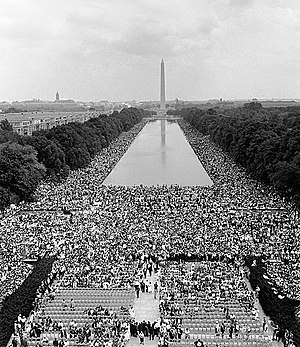
On August 28, 1963, about a quarter-million people participated in the historic March on Washington for Jobs and Freedom gathering near the Lincoln Memorial.More than 3,000 members of the press covered this historic march, in which Rev. Dr. Martin Luther King, Jr. delivered the exalted “I Have a Dream” speech.Originally conceived by renowned labor leader A. Phillip Randolph and Roy Wilkins, Executive Secretary of the NAACP, the March on Washington evolved into a collaborative effort amongst major civil rights groups and icons of the day.Stemming from a rapidly growing tide of grassroots support and outrage over the nation’s racial inequities, the rally drew over 260,000 people from across the nation.
Celebrated as one of the greatest—if not the greatest—speech of the 20th century, Dr. King’s celebrated speech, “I Have a Dream,” was carried live by television stations across the country.
Leaders of the six prominent civil rights groups at the time joined forces in organizing the march.
The group included Randolph, leader of the Brotherhood of Sleeping Car Porters; Wilkins, Executive Secretary of the NAACP; Dr. King, Chairman of the SCLC; James Farmer, founder of the Congress of Racial Equality (CORE); John Lewis, President of the Student Nonviolent Coordinating Committee (SNCC); and Whitney Young, Executive Director of the National Urban League.It didn’t take long for King’s dream to come to fruition — the legislative aspect of the dream, that is.
After a decade of continued lobbying of Congress and the President led by the NAACP, plus other peaceful protests for civil rights, President Lyndon Johnson signed into law the Civil Rights Act of 1964.
One year later, he signed the National Voting Rights Act of 1965.
Together, these laws outlawed discrimination against blacks and women, effectively ending segregation, and sought to end disenfranchisement by making discriminatory voting practices illegal.
Ten years after King joined the civil rights fight, the campaign to secure the enactment of the 1964 Civil Rights Act had achieved its goal – to ensure that black citizens would have the power to represent themselves in government.
For many African Americans growing up in the South in the 19th and 20th centuries, the threat of lynching was commonplace. The popular image of an angry white mob stringing a black man up to a tree is only half the story. Lynching, an act of terror meant to spread fear among blacks, served the broad social purpose of maintaining white supremacy in the economic, social, and political spheres.
Author Richard Wright, who was born near Natchez in southwest Mississippi, knew of two men who were lynched -- his step-uncle and the brother of a neighborhood friend. In his book Black Boy, he wrote:
"The things that influenced my conduct as a Negro did not have to happen to me directly; I needed but to hear of them to feel their full effects in the deepest layers of my consciousness. Indeed, the white brutality that I had not seen as more effective control of my behavior than that which I knew."
Lynchings (in many forms) were daily threats the kept African Americans in oppressed positions as they navigate daily life in the 20th century. However, during the reconstruction era, southerners began to reach for all reason to kill who they could no longer hold as property. Although the practice of lynching had existed since before slavery, it gained momentum during the Reconstruction Era, when viable black towns sprang up across the South and African Americans began to make political and economic inroads by registering to vote, establishing businesses, and running for public office. Many whites -- landowners and poor whites -- felt threatened by this rise in black prominence. Foremost on their minds was a fear of sex between the races. Some whites espoused the idea that black men were sexual predators and wanted integration to be with white women. This leads to the depiction of black men as ‘white women ravishing beast’. Although rape is often cited as a rationale, statistics now show that only about one-fourth of lynchings from 1880 to 1930 were prompted by an accusation of rape. In fact, most victims of lynching were political activists, labor organizers, or black men and women who violated white expectations of black deference, and were deemed "uppity" or "insolent." Though most victims were black men, women were by no means exempt.
Lynchings were frequently committed with the most flagrant public display. Like executions by guillotine in medieval times, lynchings were often advertised in newspapers and drew large crowds of white families. Lynchings were covered in local newspapers with headlines spelling out the horrific details. Photos of victims, with exultant white observers, posed next to them, were taken for distribution in newspapers or on postcards. Body parts, including genitalia, were sometimes distributed to spectators or put on public display. Most infractions were for petty crimes, like theft, but the biggest one of all was looking at or associating with white women. Many victims were black businessmen or black men who refused to back down from a fight.
Growing up, I was told of the strange fruit that hung from our southern trees. Billie Holiday song the beautiful song that rings in my mind as we travel across the south. Most don’t realize that sundown towns still exist and people still get lynched. I always say northern blacks only had to fear the government and Southern blacks had to fear the white man next door and the government. White militants terrorize southern blacks outside of the metropolitan areas and no one speaks on it. It may shock you, however, one wrong move in some parts of the south could land a rope around your neck.
The following are the lynching stories told to me as a child:
Mary Turner was a 21-year-old pregnant woman who was hung upside down from a tree and set on fire. Her unborn child was cut from her stomach and stomped to death by the angry mob. After insisting her husband, who was also lynched, did not kill his boss. Valdosta, GA (1918)
The 17year oldJesse Washington was coerced into signing a confession to raping and murdering his white boss's wife, Lucy Fryer. After pleading guilty to the crime and sentenced to death, he was dragged out of the courtroom by an angry mob. The mob proceeded to drag him through the streets by a chain wrapped around his neck. He was beaten, stabbed, dismembered, castrated, hung, and hung up on a tree where he was burned alive on May 15, 1916. This tragedy was watched by an estimated 20,000 people. The images of Washington’s murder was later sold as postcards and prints. Waco, TX (1916)
Emmett Till was a 14-year-old boy for Chicago, who was dragged out of his family’s home in Money, Mississippi after a white woman accused him of whistling at her. Her husband and brother made Emmett carry a 75-pound cotton-gin fan to the bank of the Tallahatchie River and ordered him to take off his clothes. The two men then beat him nearly to death, gouged out his eye, shot him in the head, and then threw his body, tied to the cotton-gin fan with barbed wire, into the river. Mamie Bradley, Till’s mother, demanded an open casket funeral after seeing what happened to her son. Bradley wanted the world to see what had happened to her baby.Money, Mississippi (1955)


.jpg/394px-Lynching_of_Jesse_Washington%2C_1916_(cropped).jpg)


